AI Adoption & Implementation
Helping organisations move from AI interest to real-world value
AI adoption should be driven by useful business outcomes, not technology for its own sake. Intergrated Computer and IT Solutions helps organisations identify appropriate AI use cases, prepare their data and infrastructure, select suitable models and platforms, and implement solutions that fit their security, governance and operational requirements.
Our approach supports both cloud-based and private AI environments, depending on the organisation’s data sensitivity, existing infrastructure, performance needs and governance requirements.
Strategy & Readiness
Private AI
Knowledge Assistant
Workflow Automation
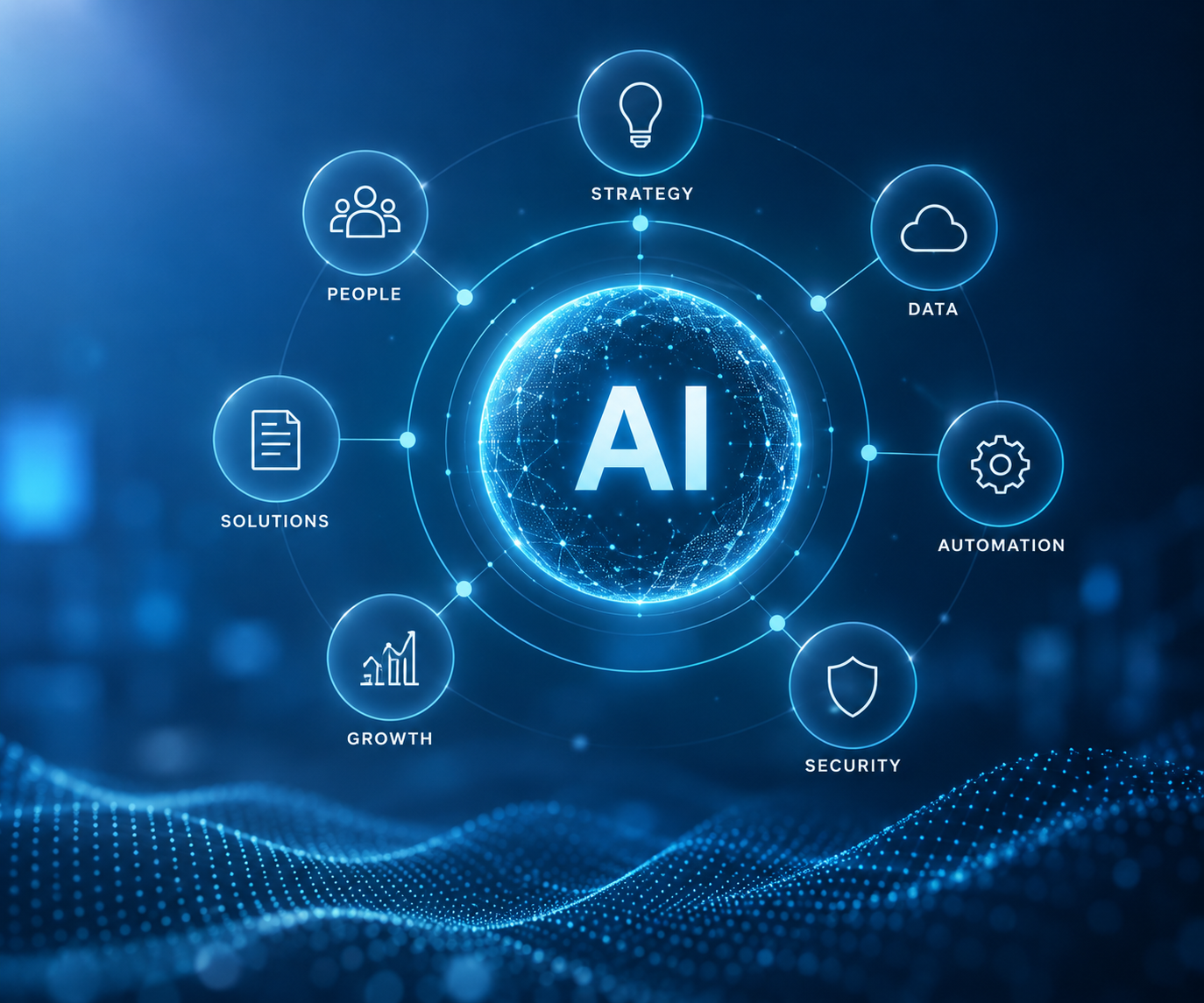
OUR AI SERVICES
Practical capabilities for secure AI adoption
Our services cover planning, implementation, integration, governance and long-term improvement.
We assess business priorities, existing systems, data availability, infrastructure, risk and organisational readiness. The outcome is a practical AI roadmap that identifies where AI can add value and what should be addressed before implementation.
AI Strategy & Readiness Assessment
For organisations handling sensitive or regulated information, we can design AI solutions that run within controlled infrastructure, including on-premise or private environments, helping organisations retain greater control over data, access and system configuration.
Private & Enterprise AI Deployment
We build AI assistants that can use approved internal information such as policies, manuals, procedures, reports and knowledge bases to provide more relevant responses while keeping the organisation’s source material central to the workflow.
Knowledge Assistants & RAG
We integrate AI into routine processes to reduce repetitive work, including document classification, information extraction, internal support, drafting assistance, summarisation, workflow routing and structured data capture.
AI Workflow Automation
Where appropriate, we help organisations evaluate and deploy open-source AI models to gain more flexibility over hosting, integration and model choice, based on the use case, infrastructure and security requirements.
Open-Source AI Model Deployment
We help organisations define access controls, data-handling practices, human review points, acceptable-use guidance, monitoring and governance measures so AI systems are introduced in a controlled and responsible manner.
AI Security, Governance & Responsible Use
AI Strategy & Readiness Assessment
We assess business priorities, existing systems, data availability, infrastructure, risk and organisational readiness. The outcome is a practical AI roadmap that identifies where AI can add value and what should be addressed before implementation.
Private & Enterprise AI Deployment
For organisations handling sensitive or regulated information, we can design AI solutions that run within controlled infrastructure, including on-premise or private environments, helping organisations retain greater control over data, access and system configuration.
Knowledge Assistants & RAG
We build AI assistants that can use approved internal information such as policies, manuals, procedures, reports and knowledge bases to provide more relevant responses while keeping the organisation’s source material central to the workflow.
AI Workflow Automation
We integrate AI into routine processes to reduce repetitive work, including document classification, information extraction, internal support, drafting assistance, summarisation, workflow routing and structured data capture.
Open-Source AI Model Deployment
Where appropriate, we help organisations evaluate and deploy open-source AI models to gain more flexibility over hosting, integration and model choice, based on the use case, infrastructure and security requirements.
AI Security, Governance & Responsible Use
We help organisations define access controls, data-handling practices, human review points, acceptable-use guidance, monitoring and governance measures so AI systems are introduced in a controlled and responsible manner.
HOW WE IMPLEMENT AI
From discovery to scale
A structured process helps ensure each implementation is useful, secure and aligned with organisational needs.
Identify business needs, pain points, users, data sources and risk constraints.
Discover
Review data readiness, infrastructure, integration requirements, security and governance.
Assess
Build a focused proof-of-concept around a clearly defined use case and measurable outcome.
Pilot
Connect the approved solution to relevant systems, data sources and user workflows.
Integrate
Apply access controls, logging, review processes and operating guidelines.
Secure & Govern
Expand successful use cases, monitor performance and refine the solution over time.
Scale & Improve
Typical AI use cases
- Internal knowledge assistants for policies, SOPs, manuals and technical documentation.
- Employee and customer support assistants with clear escalation to human teams.
- Document summarisation, classification and information extraction.
- Reporting and decision-support workflows using approved information sources.
- Automation of repetitive administrative and operational tasks.
- AI-enabled search across internal documents and knowledge repositories.
- Integration of AI capabilities into existing applications and business systems.
Why work with Integrated IT Solutions?
We start with the problem to be solved and the value expected, then choose technology accordingly.
Business-first approach
Data protection, access control and governance are considered throughout the implementation lifecycle.
Security-aware implementation
AI can be connected to existing systems, workflows, APIs, knowledge repositories and infrastructure.
Integration capability
Solutions can be designed around cloud, hybrid or private environments depending on organisational needs.
Flexible deployment options
Start with a focused AI use case
A well-defined pilot can help validate value, identify implementation requirements and build internal confidence before wider rollout.